
The Ice-Cold Truth:
Frozen Pipes and the "Negligence" Noose

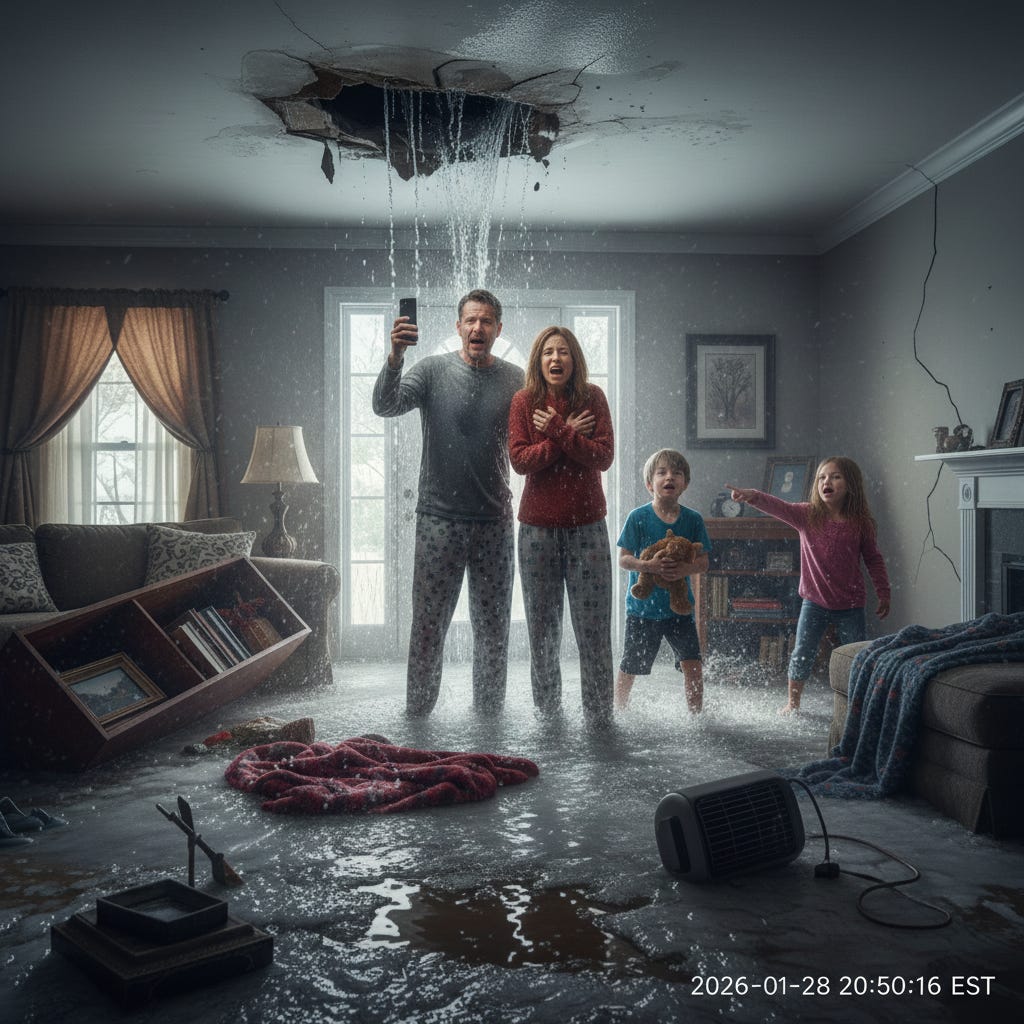
If Winter Storm Fern’s wind didn’t get your roof, its ice probably got your power. And if your power went out, your furnace died. And if your furnace died, your pipes are currently ticking like a time bomb behind your drywall.
When those pipes finally give way and turn your living room into a skating rink, don’t think for a second the insurance company is going to hand you a check with a smile. They’ve been waiting for this. They have a whole playbook designed to blame you for the laws of thermodynamics.
The “Reasonable Care” Trap
Standard policies usually cover “sudden and accidental” water discharge. But there’s a massive catch: The Heat Requirement. Most contracts state you must use “reasonable care” to maintain heat in the building. The moment you file a claim for a burst pipe, the adjuster isn’t looking at the ice on the power lines—they’re looking for a reason to say you let the house get too cold.
The Shenanigan: They’ll argue that even if the power was out, you should have drained the lines, shut off the main valve, or set up “alternative heat.” If you didn’t, they’ll slap a “Negligence” label on your claim and walk away.
How They’ll Try to Freeze You Out
1. The “Off-Premises” Power Failure Dodge: This is the nastiest trick in the book. Some policies have an exclusion for power failures that occur off your property. If a transformer blew three miles down the road and that’s why your pipes froze, they’ll argue the “proximate cause” wasn’t a covered peril on your land, but a utility issue elsewhere. They’ll tell you to go sue the electric company (good luck with that).
2. The “Seepage” Reclassification: If your pipe didn’t explode like a firecracker but instead developed a hairline fracture that leaked for 24 hours while the power was out, they’ll call it “seepage” or “gradual wear and tear.” Seepage is the “Voldemort” of insurance, they don’t cover it. They’ll claim the pipe was old and “ready to go,” and the storm was just a coincidence.
3. The “Actual Pipe” vs. “Resulting Damage” Game: This is the ultimate insult. Even if they approve the claim, they’ll often pay to fix the soggy drywall and the ruined carpet, but refuse to pay for the actual pipe repair or the repiping of the house. They consider the pipe itself “maintenance,” and the water it spilled “the accident.” It’s like paying for the bandage but making you pay for the surgery.
Jack’s Survival Guide for the Burst Pipe Blues
Keep a Power Outage Log: Don’t just say “the power was out.” Get the exact times from your utility’s app or website. If you tried to use a generator or space heaters, document it. It proves you exercised “reasonable care.”
Don’t Fix It Yet (But Stop the Bleeding): You have a duty to “mitigate” damage. Turn off the water immediately. Take 50 photos. But do not let a plumber throw away the burst section of the pipe. That piece of copper is Exhibit A. If you toss it, the insurance company will claim they can’t “verify the cause of loss.”
The “Suddenly” Clause: Use the word “Sudden” in every conversation. It wasn’t a leak; it was a sudden burst. It wasn’t a gradual freeze; it was a sudden drop in temperature following a catastrophic grid failure.
They’re hoping the ice in your veins matches the ice in your pipes. Don’t let ‘em win.
Stay Dry. Stay Dangerous.
— Jack D. Hapsburg Inssux Dispatch
"Stop guessing and start knowing. Run your estimate through the Rip-Off Detector." Detect the Rip-Off