
The Epstein Effect:
When Association Becomes a Liability

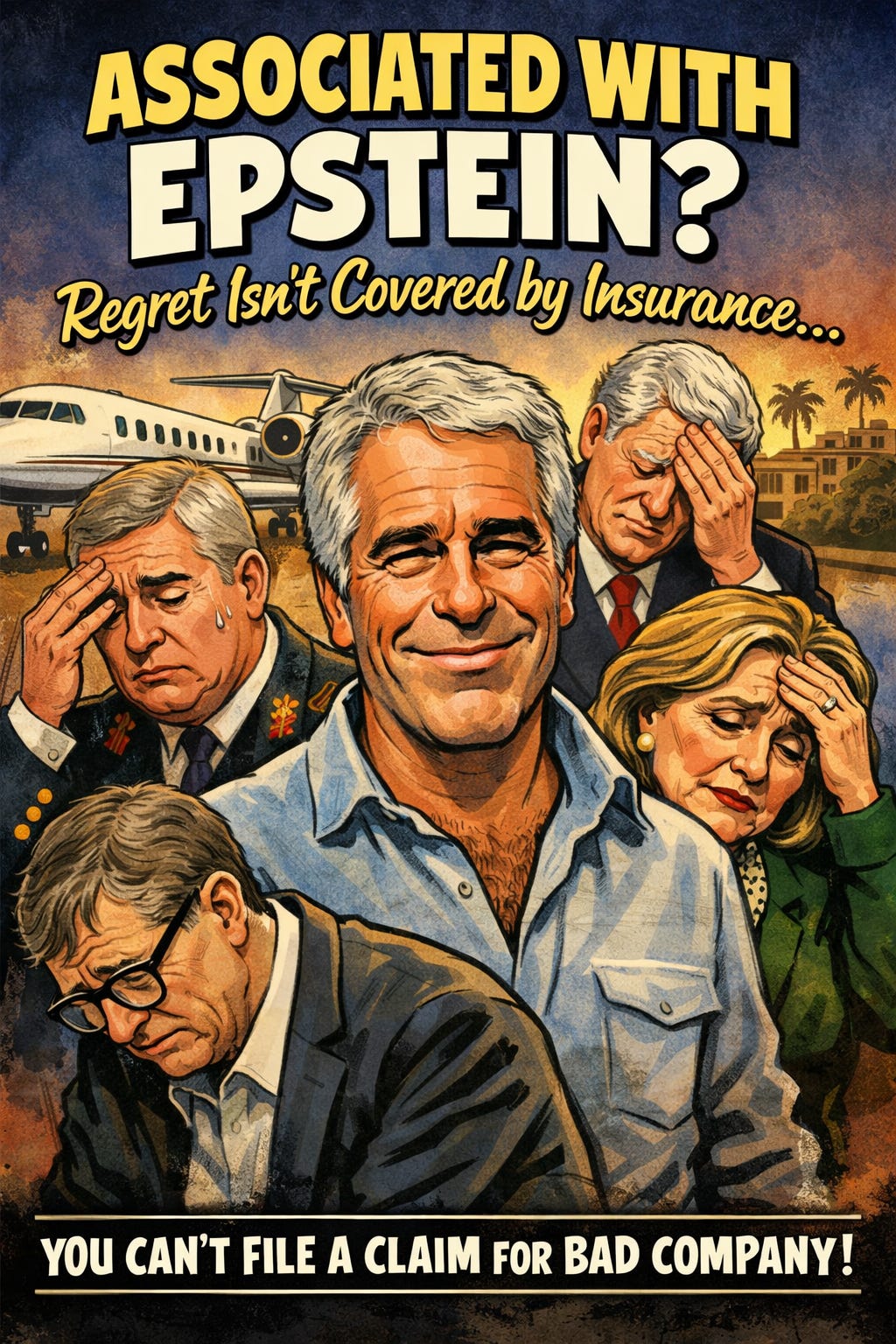
There are storms… and then there are hurricanes with guest lists.
When the name Jeffrey Epstein resurfaces in headlines, it doesn’t just drag up court files. It drags up flight logs, photo ops, fundraisers, weddings, galas, and a whole lot of “I barely knew him.”
Funny how that works.
Because here’s the uncomfortable truth: in high society, proximity is currency — until it becomes radioactive waste.
This isn’t a right-wing story.
It’s not a left-wing story.
It’s a risk story.
And Jack Hadsburg deals in risk.
The Real Question Isn’t Who Knew… It’s What It Cost
Public officials. Senators. Heads of state. Billionaires. Royalty.
We’ve seen photos and reporting involving people like Prince Andrew, Hillary Clinton, The current President. and others whose names span the political spectrum. We’ve heard statements like, “She was just an acquaintance,” referring to Ghislaine Maxwell. We’ve seen deposition transcripts. We’ve heard the distancing language.
But forget politics for a second.
Let’s talk exposure.
When Did People Know?
There’s confusion out there about timing.
Here’s what’s documented:
In 2005, Palm Beach police began investigating Epstein after complaints surfaced involving underage girls.
In 2006, he was indicted by a grand jury in Florida.
In 2008, he entered a controversial plea deal and served a short sentence.
So yes — by the mid-2000s, serious allegations were public and widely reported, especially in places like Palm Beach, where the case first unfolded.
Now here’s the insurance question:
If you continued associating with someone under that kind of scrutiny… what does that do to your risk profile?
Reputation Is an Asset — And a Liability
Let’s get technical for a minute.
For high-net-worth individuals and public figures, there are policies such as:
Directors & Officers (D&O) Insurance
Errors & Omissions (E&O)
Political Risk Insurance
Crisis Management Coverage
Reputational Harm Extensions
But here’s the kicker.
Insurance can reimburse financial loss. It cannot rewind public perception.
If your association with a controversial figure causes:
Lost donors
Cancelled contracts
Resignation pressure
Brand devaluation
Legal defense costs
Some policies might cover defense costs.
Some might cover settlement exposure.
A few might cover public relations mitigation.
But none of them restore trust.
Trust isn’t indemnifiable.
The 10-Minute Rule
Jack’s been around enough boardrooms and enough claims files to tell you this:
You can usually tell within ten minutes if someone lives in the light, or in the shadows.
Not specifics. Not crimes.
But energy.
Lifestyle.
Vibes that don’t match the polished exterior.
When you see a billionaire running in unusually secretive social circles…
When access is controlled, conversations are hushed, and patterns feel off…
You may not know the crime.
But you know something isn’t right.
And when you ignore that instinct?
That’s not politics.
That’s negligence of judgment.
Campaign Money and Cognitive Blind Spots
Here’s another uncomfortable reality.
When someone funds your campaign…
Funds your foundation…
Opens doors to powerful networks…
Your incentive to look closely decreases.
That’s human nature. Not partisan. Human.
And insurance companies understand that better than anyone.
They price risk not just on actions,
but on incentives.
The Insurance Lesson for Regular People
You might not be a senator.
You might not have D&O coverage.
But you absolutely have exposure.
Business partnerships
Investment relationships
Social affiliations
Nonprofit boards
Romantic connections
Your name can be pulled into someone else’s scandal.
And once it is, the algorithm doesn’t ask for context.
It just connects dots.
Can You Insure Your Reputation?
Short answer?
Not really.
You can insure:
Legal defense
Certain financial losses
Crisis PR expenses
But reputation is like glass.
Once cracked, you’re living with the fracture lines.
The Bigger Takeaway
Be careful who you associate with.
Run quiet background checks.
Google deeply.
Ask hard questions.
Trust your instincts.
Because knowing the wrong person can become the most expensive “claim” you ever file — and there may not be coverage for it.
Now Let’s Bring This Home
Insurance companies deny claims every day for “material misrepresentation.”
Meaning?
You didn’t disclose something material to the risk.
Now flip that around.
What are you not disclosing to yourself about the risks around you?
That’s where bad outcomes start.
Before You Sign Anything…
If you’ve been denied, delayed, or lowballed on a claim, don’t assume it’s final.
Take the Ripoff Detector — five quick questions that tell you if your insurer may be playing games.
And if you want straight answers?
Ask Jack.
We’re expanding Ask Jack to Spanish — covering the majority of American households — and more languages are coming.
He’s not a chatbot.
He’s a digital concentration of 30 years in the insurance trenches.
Claims files. Policy language. Industry tactics. Deep pattern recognition.
You can ask him anything about your coverage, your exposure, or whether your insurer is turning the tables on you.
Because here’s the truth:
It’s not just about avoiding scandal.
It’s about understanding risk before it owns you.
And that’s something no headline will ever teach you.
But we will. Go to Inssux.com for all the answers