
College Football Just Became a Payroll War.
Now Who Insures the Kids?

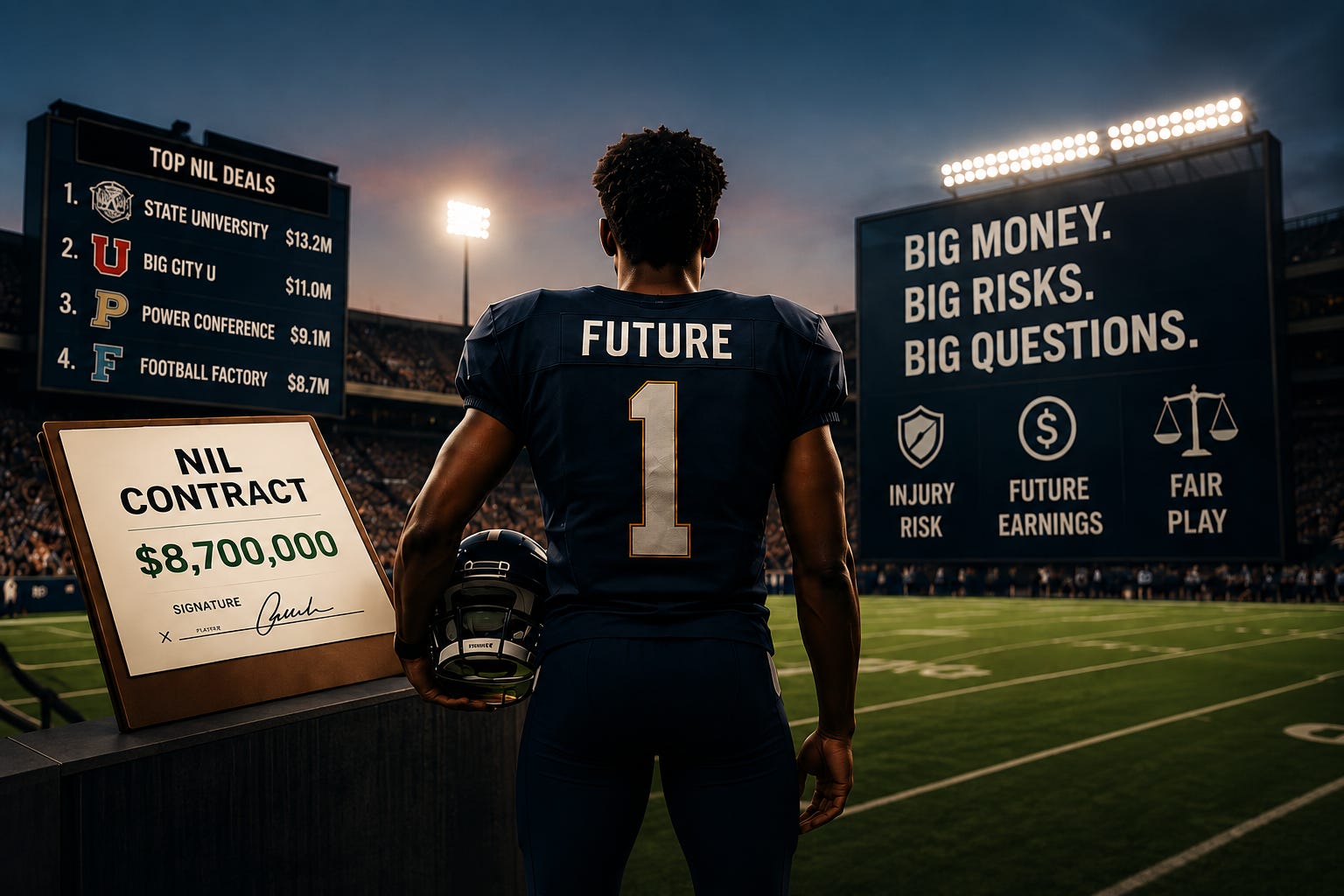
College sports has finally admitted what everybody with two eyes and a remote control already knew:
These kids are working.
They are not just “student-athletes” running around for school spirit, orange slices, and a scholarship that disappears the minute their knee points the wrong direction. They are performers. They are revenue engines. They are Saturday inventory. And yes, they deserve to be paid.
Good. Pay them.
But now comes the part nobody wants to talk about because it ruins the pep rally.
If the biggest schools can buy the best quarterbacks, the best receivers, the best pass rushers, and the best offensive linemen, then what exactly are we building? A college football playoff — or a country club with helmets?
The NFL has a salary cap for a reason. Not because billionaires suddenly found fairness in their couch cushions. It exists because without some guardrails, the rich teams would hoard the talent, the poor teams would become punching bags, and the league would eventually bore everybody to death.
College football may be heading for the same ditch, only with fight songs.
The new NIL/revenue-sharing era is trying to put structure around chaos. That is a start. But it also opens a giant insurance question:
Who protects the athlete when the athlete is now the asset?
A superstar quarterback may be worth millions before he ever takes an NFL snap. His arm, knees, ankles, shoulders, and brain are now part of a financial projection. His family may be counting on that future. His school may be building a season around it. His sponsors may be attaching checks to it.
So when does the insurance conversation start?
Senior year of college?
Too late.
Freshman year?
Maybe.
High school?
Now we are getting warmer.
Eighth grade?
That sounds insane — until you realize scouts, trainers, camps, rankings, and shoe-company whisper networks are already treating some kids like futures contracts with algebra homework.
And here is where it gets wild.
Can a quarterback insure himself against a career-ending injury? Yes, in concept.
Can he insure against losing future contract value if he gets hurt and drops in the draft? Yes, for top-tier prospects, that world already exists.
Can his family insure the future earnings they believe are coming? Maybe, but only if the policy is properly structured, properly underwritten, and actually pays when the nightmare happens.
And then there is the blind side question.
Can a quarterback buy insurance on his offensive linemen?
After all, those guys are protecting his body, his NIL money, his draft stock, and maybe his family’s future. One missed block can turn a Heisman campaign into a hospital chart.
But insurance is not fantasy football with paperwork. You usually need an insurable interest. In normal English: you need a legitimate financial stake in what you are insuring. You cannot just take out a policy on the left tackle because he is large and useful. That gets creepy fast.
Could a team, school, collective, or athlete contract be structured to recognize shared financial risk? Maybe someday. But the insurance industry is going to need new products, new rules, and new honesty. That last part is where the wheels usually come off.
Because when money shows up, denial letters follow.
Here is the real issue: college sports is now professional enough to create professional-level risk, but not honest enough yet to provide professional-level protection.
The athlete gets paid.
The school gets protected.
The boosters get influence.
The networks get content.
The agents get a slice.
The lawyers get dessert.
But when the kid gets hurt, who gets stuck reading the fine print?
That is where Inssux comes in.
We are not against athletes getting paid. Pay them. They earned it.
But if college sports wants to become a business, then it needs business-grade protection: disability coverage, loss-of-value coverage, medical protection, contract review, NIL interruption coverage, family planning, and a real explanation of who pays what when the dream tears an ACL.
And yes, maybe college football needs a real salary cap or spending cap that works — not a fake cap with booster loopholes big enough to drive a team bus through.
Because fairness matters twice.
It matters when the athlete gets paid.
And it matters when the athlete gets hurt.
Jack’s verdict:
Pay the kids. Cap the chaos. Insure the future.
And for the love of Touchdown Jesus, stop pretending this is amateur hour.
It is a business now.
So protect the workers.
Take the five question quiz to make sure you’re not getting ripped off. Ripoff detector