
Bleached Out
How Cyber Insurance is Fading to White

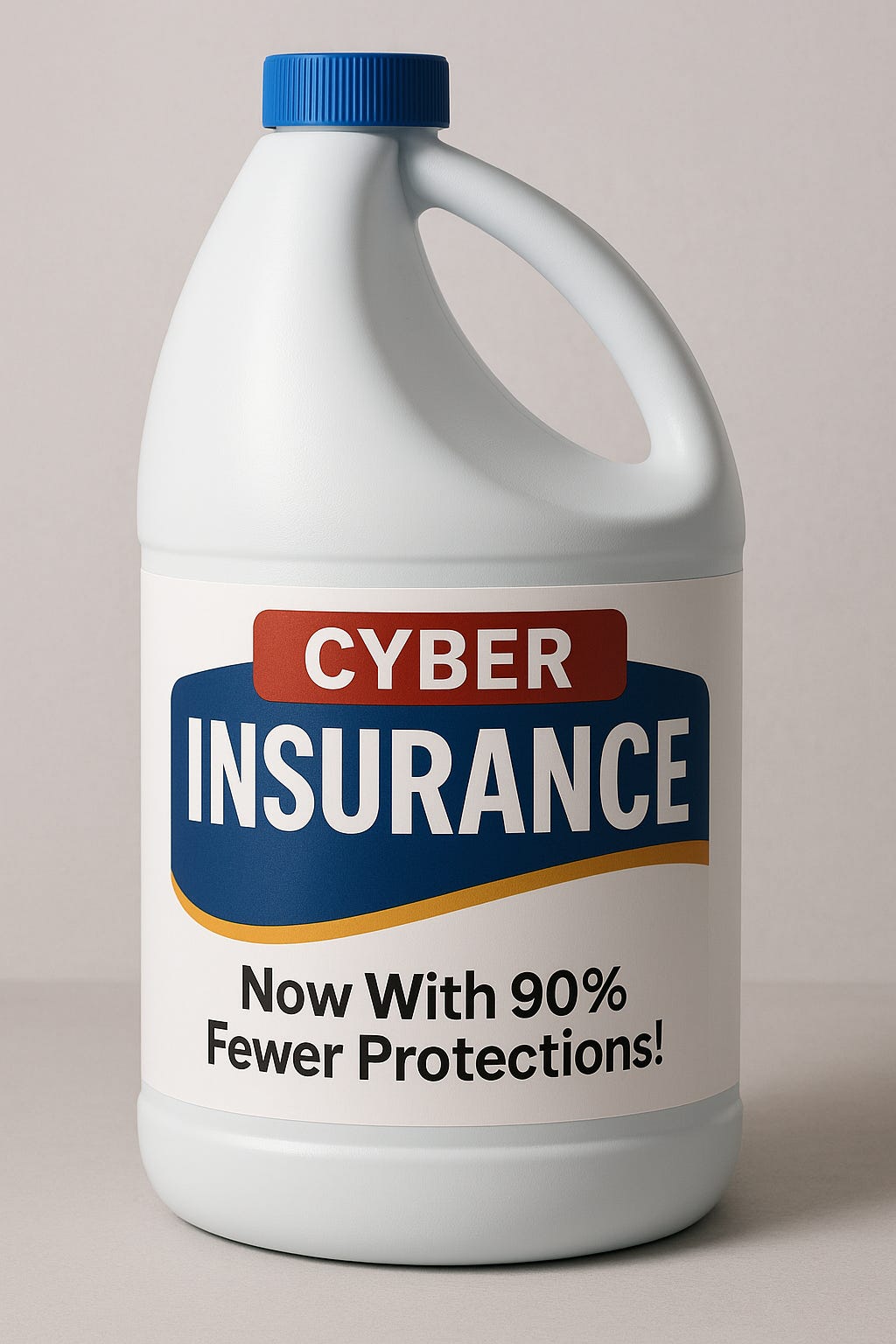
Cyber insurance is quietly disappearing. Not because hacks are rare, but because they’re too common, too human, and too costly.
We live in a world where billion-dollar companies get locked down because someone on the other side of the world picked up a phone, pretended to be a Clorox employee, and asked nicely for the keys to the kingdom. No brute force. No spyware. Just a little social engineering, or in this case, just plain human laziness.
Yet the insurance industry—rather than adapting—has responded by "bleaching out" coverage entirely. High deductibles. Narrow definitions. Exclusions buried in digital fine print. And when a real cyberattack hits? Good luck collecting.
Suggested Post Structure (with sample paragraphs):
🧼 The $380 Million Phone Call
In 2023, a hacker called the Clorox help desk, asked for login credentials, and got them. That simple. The result? $380 million in damage, $50 million of that in cleanup costs alone. The group responsible, “Scattered Spider,” didn’t need a sophisticated exploit, just a working phone number and an accommodating support rep from Cognizant.
This wasn’t Mission: Impossible. It was Mission: Incompetent.
💻 Why Insurance Won’t Save You
Cyber insurers took one look at these growing losses and slammed the brakes. Many policies now come with exclusions for social engineering. Some carve out coverage if the attack began due to "human error." Others stack deductibles so high that unless you’re a Fortune 500 firm, it’s practically worthless.
The result? You think you're protected, but your coverage is like bleach on a black shirt, faded, patchy, and full of holes.
📞 Outsourced, Underpaid, and Overexposed
Let’s be honest: many customer service and IT help desks are outsourced to the lowest bidder, often in countries where wages are a fraction of U.S. standards. When someone in the Philippines or India is making $2 an hour and gets offered $200 to “reset a password,” that’s not an ethical dilemma, that’s a payday.
And from their perspective? You’re rich. They think it’s all covered by insurance anyway. (Spoiler: it’s not.)
🛡️ So Who’s Really At Risk?
Everyone. Whether you're Clorox or a small business using a cheap IT contractor, the weakest link is always the same: a person on a headset, barely trained and completely vulnerable to a clever voice and a fake name.
The real tragedy? When the damage is done, your insurer is more likely to ghost you than pay you.
Conclusion & CTA:
You can’t outsource responsibility.
You can’t insure stupidity.
And you sure as hell can’t ignore the growing cost of cyber ignorance.
At Inssux, we expose the cracks in the system—so you’re not left cleaning up a $380 million mess with a bottle of bleach.
Suggested Hashtags:
#CyberRisk #InsuranceExclusions #BleachOut #ScatteredSpider #Inssux #DigitalNegligence #DataBreach #SocialEngineering