
Autonomous Recall:
When the Robotaxi Hits the Water, Who Pays?

Well, folks, welcome to the future.
The car drives itself. The steering wheel is optional. The driver is invisible. The software is smarter than your cousin who still thinks “deductible” is a vitamin.
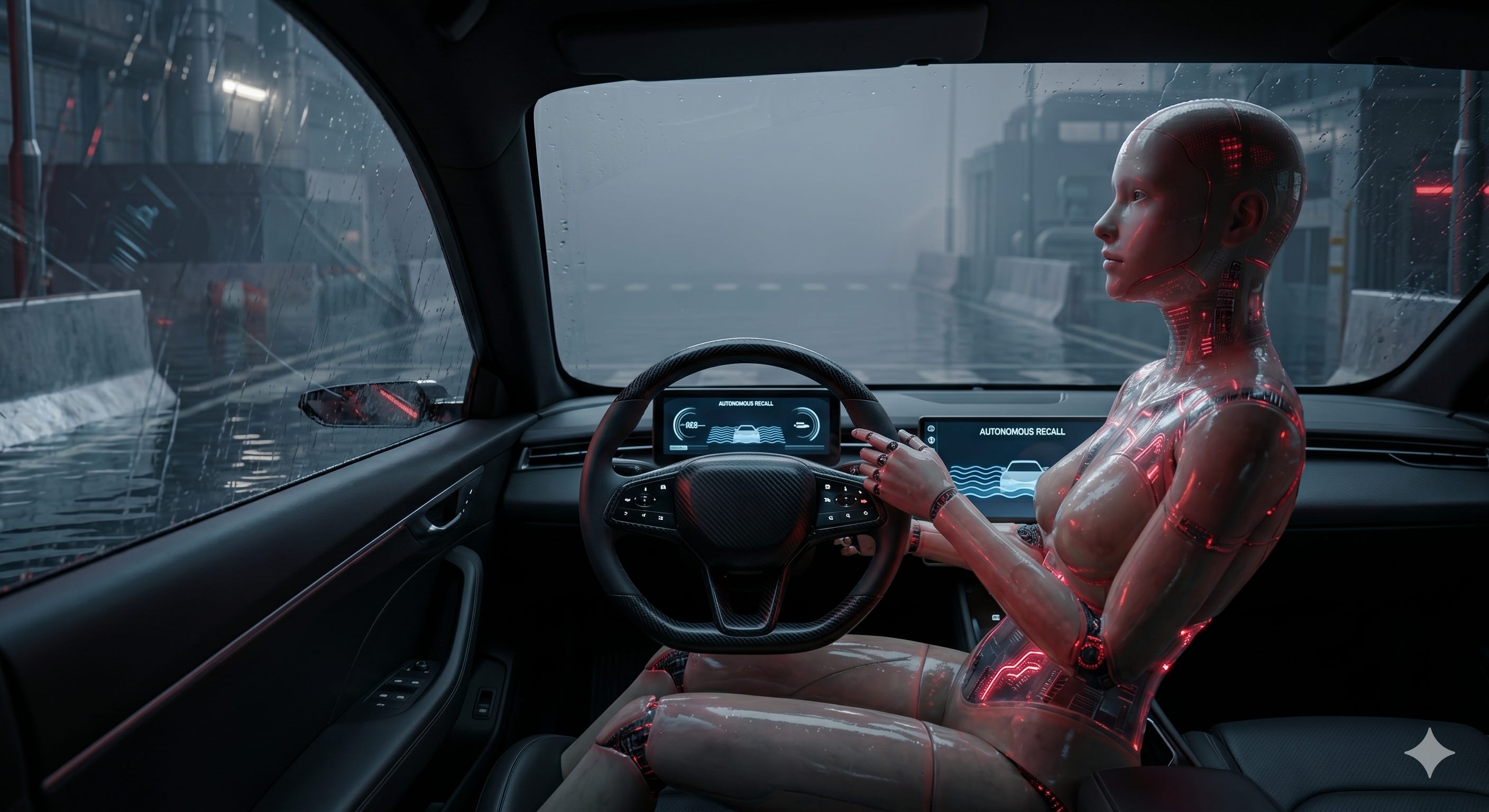
And yet, here we are: Waymo has issued a voluntary software recall covering roughly 3,791 autonomous vehicles after a driverless vehicle in San Antonio entered a flooded roadway during severe weather. The vehicle was reportedly unoccupied, and thankfully, nobody was hurt. But the problem was real: the system detected the hazard, slowed down, and still proceeded into water it should not have entered. That is not a tiny hiccup. That is the machine saying, “I see the creek, but I’m going in anyway.”
Waymo says it is improving software safeguards, tightening extreme-weather operations, restricting access to flood-prone areas, and updating maps. Good. That is exactly what should happen. New technology has bugs. Every major technology does. Airplanes had bugs. Elevators had bugs. Smartphones had bugs. Heck, even your refrigerator now needs a software update, which is why civilization may already be doomed.
But here is the InsSux question:
When the robot makes the mistake, who writes the check?
The Technology Is Impressive — But It Is Not Magic
Let’s be fair. Autonomous driving is not some carnival trick. Waymo has spent years building sensors, mapping systems, AI decision-making, and safety procedures. The company says its system uses detailed maps, real-time sensor data, and AI to plan routes, interpret objects, and make driving decisions without a human driver from pickup to destination.
That is impressive.
But impressive does not mean perfect.
The recent recall reportedly involved a scenario where vehicles could slow down near standing water on higher-speed roads but fail to stop completely when the flooded section was not safely passable. That matters because floodwater is not just “a puddle with ambition.” It can hide depth, current, debris, washed-out pavement, and the kind of surprise that turns a smart car into a very expensive bobber.
No injuries this time. Good.
But insurance is not built around “this time.” Insurance is built around what happens next time.
So Who Pays If You’re Riding in One?
Here is where the pavement gets slippery.
If you are riding in a conventional taxi or rideshare and there is a crash, the claim usually starts with the company’s commercial auto coverage, the driver’s coverage if applicable, and sometimes your own medical or auto coverage depending on your state.
With a robotaxi, there may be no human driver to blame.
That means responsibility could potentially land on several players:
The autonomous vehicle operator.
The software system.
The manufacturer.
A maintenance contractor.
A mapping/data provider.
Another human driver.
A city or road authority if road conditions or signage contributed.
And yes, the insurance company — because eventually somebody has to open the wallet, and they usually open it slowly, with one hand on the exclusions page.
NHTSA itself notes that liability and insurance remain major questions as automated driving systems mature and reach broader public use. Translation: the regulators know this is complicated, and the rulebook is still being written while the robotaxis are already rolling.
Does Your Personal Auto Insurance Follow You?
Now here is the part most people do not think about.
When you step into an autonomous taxi, you are usually not “driving.” You are a passenger. Your own personal auto policy may not work the way you assume it does.
Depending on the state and your policy, your own coverage might help through medical payments, personal injury protection, uninsured/underinsured motorist coverage, or health insurance. But do not assume your regular car insurance automatically becomes your bodyguard just because you are inside a vehicle.
That is where people get burned.
They assume coverage is simple.
Then the adjuster shows up wearing a smile and carrying a chainsaw.
Some states have specific rules for autonomous rideshare insurance. For example, some legal summaries note that California requires autonomous rideshare companies to carry substantial liability coverage, often discussed around the $5 million level for commercial autonomous ride services. But coverage rules can vary by state, city, operating permit, and the type of service being offered.
So before you hop in, the smart question is not, “Is this cool?”
The smart question is:
“If this thing crashes, who is covering me, and how much?”
Are There Experimental Technology Exclusions?
This is the meat on the bone.
Could an insurance company try to deny coverage by pointing to exclusions involving experimental technology, autonomous systems, software defects, commercial use, or product liability?
Maybe.
Not always. Not automatically. But maybe.
The bigger the claim, the harder everyone looks for an exit door. That is not cynicism. That is claims reality.
A billion-dollar company may carry serious insurance. But that does not mean every injured person gets paid quickly, cleanly, and without a fight. After a crash, the questions start flying:
Was the vehicle operating within its approved service area?
Was the weather within operational limits?
Had the latest software update been installed?
Was the recall remedy completed?
Was another driver involved?
Was the passenger wearing a seatbelt?
Was the injury caused by the autonomous system, the road condition, another vehicle, or some combination?
That is when “innovative mobility experience” turns into “please hold while we investigate.”
The Real Risk: Not No Coverage — Confused Coverage
The biggest risk may not be that there is no insurance. The bigger risk is coverage confusion.
Big companies like Waymo are not running around with no coverage like some guy hauling scrap metal in a van with three bald tires and a dream. But the autonomous world creates a new kind of claims maze.
With old-school crashes, the argument is usually:
Who was at fault?
With autonomous crashes, the argument becomes:
Which system made the decision, who controlled that system, who insured that system, and what did the policy exclude?
That is a different animal.
And when a claim involves multiple companies, software logs, mapping data, vehicle telemetry, weather conditions, product liability, and state regulatory rules, the average person can get swallowed whole.
That is why you need to think before you ride.
Not because autonomous vehicles are bad.
Because insurance companies love confusion the way raccoons love trash cans.
Jack’s Rider Checklist Before You Trust the Robot
Before you step into an autonomous vehicle, especially in bad weather, ask yourself:
1. Is this ride operating in a fully approved service area?
Do not be the test dummy in the gray zone.
2. What company operates the vehicle?
Waymo, Zoox, Tesla, Cruise, or some startup with a logo that looks like it was designed during a Red Bull overdose — know who is responsible.
3. Does the company disclose insurance coverage?
If they make it hard to find, that tells you something.
4. Do you have medical payments, PIP, or good health coverage?
Your body does not care whether the crash was caused by a person or a processor.
5. Do you carry uninsured/underinsured motorist coverage?
If another driver causes the crash and does not have enough insurance, this may matter.
6. Was there a recall or software update issue?
After this Waymo recall, that question is no longer science fiction. It is Tuesday.
7. Document everything after an incident.
Screenshots, ride receipts, app details, vehicle number, location, photos, witness names, police report, medical records. Evidence is your friend. Memory is a slippery little weasel.
The Bottom Line
I am not anti-technology.
I am anti-getting-left-holding-the-bag.
Autonomous vehicles may become safer than human drivers. They may save lives. They may reduce drunk driving, distracted driving, road rage, and half the nonsense we see every day from people who should not be trusted with a shopping cart, let alone a steering wheel.
But the Waymo recall is a reminder: the future still needs a claims department.
And when the future crashes into a flooded road, somebody has to pay.
The question is whether that somebody is the company, the insurer, another driver, your health plan, your own policy — or you.
At InsSux, we believe in using new technology, not worshipping it. We believe in giving people the tools to spot the holes before they fall through them.
Because the robot may be driving.
But you still better know who’s covering the ride.
InSucks.com
Straight talk. Real solutions. InsSux.com